1. The vernier scale of a calliper is divided into 30 divisions which coincide with 29 main scale divisions. Each main scale division is 0.3 mm. The least count of the instrument is:
1. 0.03 mm
2. 0.01 mm
3. 0.15 mm
4. 0.3 mm
2. Let main scale division be of \(1~ \text{mm}\) and 50 divisions of vernier scale coincide with 49 divisions of main scale.
The least count of instrument is:
1. \(0.01 \text{ mm}\)
2. \(0.1 \text{ mm}\)
3. \(0.02 \text{ mm}\)
4. \(0.002 \text{ mm}\)
3. A vernier calliper has \(1 \text{ mm}\) mark on the main scale. It has \(20\) equal divisions on the vernier scale which match with \(12\) main scale divisions. Its least count is:
1. \(0.1 \text{ mm}\)
2. \(0.2 \text{ mm}\)
3. \(0.4 \text{ mm}\)
4. \(0.6 \text{ mm}\)
4. \(n-\)divisions on the main scale of a vernier calipers coincide with \(n+1\) divisions on the vernier scale. If each division on the main scale is of \(x\) units, determine the least count of the instrument:
1. \(\frac{x}{n}\)
2. \(\frac{x}{n+1}\)
3. \(\frac{x}{n-1}\)
4. \(\frac{2 x}{n+1}\)
5. The dimensions of a rectangular block measured with a vernier calliper having least count \(0.1 \text{ mm}\) is \(5.0 \mathrm{~mm} \times 10.0 \mathrm{~mm} \times 10.0 \mathrm{~mm} .\) The maximum percentage error in the measurement of volume of the bock is:
1. \(5 \%\)
2. \(10 \%\)
3. \(15 \%\)
4. \(4 \%\)
6. The smallest division on main scale of a vernier calliper is \(1 \text{ mm}\) and 10 vernier scale divisions coincide with 9 main scale divisions. While measuring the length of a line, the zero mark of the vernier scale lies between \(10.2 \text{ cm}\) and \(10.3 \text{ cm}\) and the third division of vernier scale coincide with a main scale division. Find the length of wire:
1. \(10.03 \text{ cm}\)
2. \(10.33 \text{ cm}\)
3. \(10.2 \text{ cm}\)
4. \(10.23 \text{ cm}\)
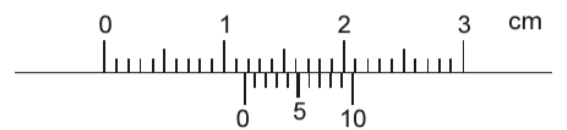
7. If the least count of the scale shown is
\(0.1 \text{ mm}\) , then the reading the vernier caliper shows is:
1.
\(11.72 \text{ mm}\)
2.
\(11.5 \text{ mm}\)
3.
\(11.7 \text{ mm}\)
4.
\(10.7 \text{ mm}\)
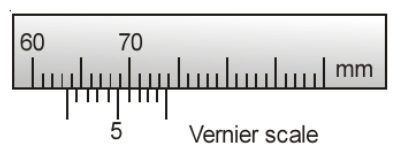
8. What is the reading of the vernier scale shown in the figure?
1.
\(60.7 \mathrm{~mm}\)
2.
\(61.3 \mathrm{~mm}\)
3.
\(62.4 \mathrm{~mm}\)
4.
\(63.7 \mathrm{~mm}\)
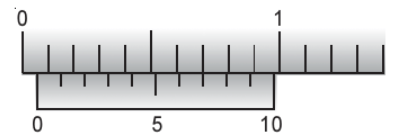
9. The figure shows a situation when jaws of vernier are touching each other and one main scale division is of
\(1 \mathrm{~mm} .\) The zero correction in reading measured will be:
1.
\(0.5 \mathrm{~mm}\)
2.
\(0.7 \mathrm{~mm}\)
3.
\(-0.5 \mathrm{~mm}\)
4.
\(-0.7 \mathrm{~mm}\)
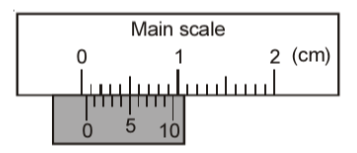
10. The figure shows a situation when the jaws of vernier are touching each other.
Each main scale division is of
\(1 \mathrm{~mm}\) and
\(5^{\text {th }}\)division of vernier scale coincides with a main scale division.
The zero error of the instrument is:
1.
\(+0.5 \mathrm{~mm}\)
2.
\(-0.5 \mathrm{~mm} \)
3.
\(+0.9 \mathrm{~mm}\)
4.
\(-0.1 \mathrm{~mm}\)
*If above link doesn't work, please go to test link from where you got the pdf and fill OMR from there
CLICK HERE to get FREE ACCESS for 2 days of ANY NEETprep course
 MCQs based on Experiment: Vernier CallipersContact Number: 8527521718