Botany - Section A
1. Which of the following will not be applicable for China rose?
1. Alternate phyllotaxy
2. Hypogynous flower
3. Valvate aestivation for corolla
4. Monoadelphous stamens
2. When the margins of sepals or petals overlap one another without any particular direction, the condition is termed as:
| 1. |
Vexillary |
2. |
Imbricate |
| 3. |
Twisted |
4. |
Valvate |
3. Which of the following describes the given graph correctly?

| 1. |
Endothermic reaction with energy A in the presence of enzyme and B in the absence of enzyme |
| 2. |
Exothermic reaction with energy A in the presence of enzyme and B in the absence of enzyme |
| 3. |
Endothermic reaction with energy A in the absence of enzyme and B in the presence of enzyme |
| 4. |
Exothermic reaction with energy A in the absence of enzyme and B in the presence of enzyme |
4. Plants which produce characteristic pneumatophores and show vivipary belong to:
| 1. |
Halophytes |
2. |
Psammophytes |
| 3. |
Hydrophytes |
4. |
Mesophytes |
5. The vascular bundle shown in the diagram is most likely to be seen in:

| 1. |
Monocot stem |
2. |
Dicot stem |
| 3. |
Monocot root |
4. |
Dicot root |
6. The type of biochemical reaction shown in the figure is catalysed by a group of enzymes called as:

| 1. |
Transferases |
2. |
Lyases |
| 3. |
Ligases |
4. |
Oxidoreductases |
7. The main difference between taxonomy and systematics is that:
| 1. |
Taxonomy is involved in the naming and classification of organisms while systematics is involved in determining evolutionary relationships between organisms. |
| 2. |
Systematics is involved in the naming and classification of organisms while taxonomy is involved in determining evolutionary relationships between organisms. |
| 3. |
Taxonomy is not a true science and has largely been replaced with systematics. |
| 4. |
Systematics can be considered as a part of taxonomy. |
8. The primary acceptor in plants is:
| 1. |
RuBP in mesophyll cells |
| 2. |
RuBP in bundle sheath cells |
| 3. |
PEP in mesophyll cells |
| 4. |
PEP in bundle sheath cells |
9. The numbers of ATP and NADPH molecules required to make one molecule of glucose through the Calvin pathway, respectively, are:
1. 9 and 6
2. 18 and 12
3. 6 and 9
4. 12 and 18
10. In Calvin Cycle, the first CO2 fixation product is:
1. 3-phosphoglyceric acid
2. phosphoenolpyruvate
3. oxaloacetic acid
4. malic acid
11. Consider the following statements regarding C4 photosynthesis plants-
| I: |
PEP is primary CO2 acceptor. |
| II: |
OAA is primary CO2 fixation product. |
| III: |
RuBisCO is not present in these plants. |
Which of the above statements are true?
| 1. |
I and II only |
2. |
I and III only |
| 3. |
II and III only |
4. |
I, II, and III |
12. The and photosynthesis pathways are so called because the initial carbon fixation product in them are respectively:
| 1. |
pyruvate; malate |
| 2. |
malate; pyruvate |
| 3. |
3-phosphoglycerate; oxaloacetic acid |
| 4. |
glyceraldehyde 3-phosphate; phospho-enol-pyruvate (PEP) |
13. All the following are known functions of the plant growth regulator auxins except:
| 1. |
Promotion of flowering in pineapples |
| 2. |
Induction of parthenocarpy in tomatoes |
| 3. |
Fruit ripening in tomatoes |
| 4. |
Initiation of rooting in stem cuttings |
14. Select the correct explanation of the structure shown in the given figure as your answer:

| 1. |
The chromosome shown is metacentric and X is centromere |
| 2. |
The chromosome shown is metacentric and X is satellite |
| 3. |
The chromosome shown is sub-metacentric and X is centromere |
| 4. |
The chromosome shown is sub-metacentric and X is satellite |
15. Consider the given two statements:
| Assertion (A): |
Plant growth is intimately linked to the water status of the plant. |
| Reason (R): |
The plant cells grow in size by cell enlargement, which in turn requires water. |
| 1. |
(A) is True but (R) is False |
| 2. |
Both (A) and (R) are True and (R) correctly explains (A) |
| 3. |
Both (A) and (R) are True and but (R) does not correctly explain (A) |
| 4. |
(A) is False but (R) is True |
16. The component molecules of the cell membrane have two main parts, the head and the tail. These parts are either hydrophobic (repelled by water) or hydrophilic (attracted to water). Which is which?
| 1. |
Hydrophilic Head and Hydrophobic Tail |
| 2. |
Both Hydrophobic |
| 3. |
Hydrophilic Tail and Hydrophobic Head |
| 4. |
Both Hydrophilic |
17. Apical dominance in plants can be overcome by the application of the PGR:
| 1. |
Cytokinin |
2. |
Ethylene |
| 3. |
ABA |
4. |
Gibberellins |
18. The cell shown in the given figure is at:
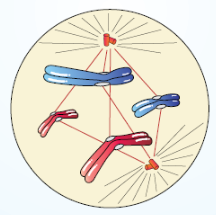
| 1. |
Early Prophase |
2. |
Transition to Metaphase |
| 3. |
Anaphase |
4. |
Telophase |
19. Given below are two statements:
| Statement I: |
Membrane-bound organelles of the endomembrane system coordinate cellular functions. |
| Statement II: |
Mitochondria and chloroplasts are not considered a part of the endomembrane system. |
In the light of the above statements, choose the most appropriate answer from the options given below
| 1. |
Statement I is correct but Statement II is incorrect |
| 2. |
Statement I is incorrect but Statement II is correct |
| 3. |
Both Statement I and Statement II are correct |
| 4. |
Both Statement I and Statement II are incorrect |
20. A prokaryotic autotrophic nitrogen-fixing symbiont is found in:
| 1. |
Cycas |
2. |
Cicer |
| 3. |
Pisum |
4. |
Alnus |
21. Given below are two statements:
| Statement I: |
The phenomenon by which the undividing parenchyma cells start to divide mitotically during plant tissue culture is called as dedifferentiation. |
| Statement II: |
The ability of plants to follow different pathways in response to environment leading to formation of different kinds of structures is called plasticity. |
In the light of the above statements, choose the most appropriate answer from the options given below
| 1. |
Statement I is correct but Statement II is incorrect |
| 2. |
Statement I is incorrect but Statement II is correct |
| 3. |
Both Statement I and Statement II are correct |
| 4. |
Both Statement I and Statement II are incorrect |
22. You are given a tissue with its potential for differentiation in an artificial culture. Which of the following pairs of hormones would you add to the medium to secure shoots as well as roots?
1. IAA and gibberellin
2. Auxin and cytokinin
3. Auxin and abscisic acid
4. Gibberellin & abscisic acid
23. Liquid endosperm in coconut forms due to:
| 1. |
Failure of cytokinesis after karyokinesis |
| 2. |
Failure of karyokinesis before cytokinesis |
| 3. |
Disruption of spindle fibers at metaphase |
| 4. |
Continued DNA replication during cytokinesis |
24. A basal body is a part of bacterial:
| 1. |
Inclusion bodies |
2. |
Chromosomal DNA |
| 3. |
Flagellum |
4. |
Plasmid |
25. Which one of the following statements is wrong?
| 1. |
Algae increase the level of dissolved oxygen in the immediate environment |
| 2. |
Algin is obtained from red algae and carrageenan from brown algae |
| 3. |
Agar-agar is obtained from Gelidium and Gracilaria |
| 4. |
Laminaria and Sargassum are used as food |
26. How many ATP molecules are produced by the Aerobic oxidation of one molecule of glucose:
1. 2
2. 4
3. 38
4. 34
27. The taxonomic unit ‘Phylum’ in the classification of animals is equivalent to which hierarchical level in classification of plants?
| 1. |
Class |
2. |
Order |
| 3. |
Division |
4. |
Family |
28. NADH
+ H
+ is reoxidised to NAD
+ in:
| I: |
Ethanol fermentation |
| II: |
Lactate fermentation |
1. Only
I
2. Only
II
3. Both
I and
II
4. Neither
I nor
II
29. Match each item in Column I with one in Column II and select the correct match from the codes given:
|
Column I
[Respiratory substrate] |
|
Column II
[RQ Value] |
| A |
Carbohydrates |
P |
1 |
| B |
Proteins |
Q |
0.9 |
| C |
Tripalmitin |
R |
More than 1 |
| D |
Organic acids |
S |
0.7 |
Codes:
|
A |
B |
C |
D |
| 1. |
Q |
P |
R |
S |
| 2. |
Q |
P |
S |
R |
| 3. |
P |
Q |
R |
S |
| 4. |
P |
Q |
S |
R |
30. Choose the wrong statement:
| 1. |
Penicillium is multicellular and produces antibiotics. |
| 2. |
Neurospora is used in the study of biochemical genetics. |
| 3. |
Morels and truffles are poisonous mushrooms. |
| 4. |
Yeast is unicellular and useful in fermentation. |
31. The imperfect fungi which are decomposers of litter and help in mineral cycling belong to?
| 1. |
Deuteromycetes |
2. |
Basidiomycetes |
| 3. |
Phycomycetes |
4. |
Ascomycetes |
32. Numbers of points in the Krebs cycle where NAD+ is reduced to NADH + H+ and where FAD+ is reduced to FADH2 respectively are:
| 1. |
1 and 3 |
2. |
3 and 1 |
| 3. |
2 and 4 |
4. |
4 and 2 |
33. Identify the incorrect statement regarding cyanobacteria:
| 1. |
They have chlorophyll a (similar to green plants) |
| 2. |
They are unicellular and never colonial or filamentous |
| 3. |
They often form blooms in polluted water bodies |
| 4. |
Some of them can fix atmospheric nitrogen |
34. Consider the two statements:
| Assertion (A): |
It is better to consider the respiratory pathway as an amphibolic pathway rather than as a catabolic one. |
| Reason (R): |
The respiratory pathway is involved in both anabolism and catabolism. |
| 1. |
Both (A) and (R) are True and (R) is the correct explanation of (A). |
| 2. |
Both (A) and (R) are True but (R) is not the correct explanation of (A). |
| 3. |
(A) is True but (R) is False. |
| 4. |
Both (A) and (R) are False. |
35. The cell walls of diatoms are ‘indestructible’ as they are embedded with:
| 1. |
Silica |
2. |
Chitin |
| 3. |
Calcium |
4. |
Raphides |
Botany - Section B
36. What is the number of ATP molecules produced by substrate-level phosphorylation from the complete breakdown of a single molecule of glucose in the presence of oxygen?
37. The phenetic classification of organisms is based on:
| 1. |
The ancestral lineage of existing organisms |
| 2. |
Dendrogram based on DNA characteristics |
| 3. |
Sexual characteristics |
| 4. |
Observable characteristics of existing organisms |
38. What is true for both (a) and (b)?

1. RNA is the genetic material
2. Capability to infect bacteria
3. Being obligate endoparasites
4. Can be killed by antibiotics
39. Flagella of prokaryotic and eukaryotic cells differ in:
| 1. |
Location in cell and mode of functioning |
| 2. |
Microtubular organization and type of movement |
| 3. |
Microtubular organization and function |
| 4. |
Type of movement & placement in the cell |
40. How many of the given statements are correct?
| I: |
The major lipids in cell membrane are phospholipids that are arranged in a bilayer. |
| II: |
The ability of lipids and carbohydrates to move laterally within the membrane is measured by its fluidity. |
| III: |
In addition to phospholipids, the animal cell membrane also contains cholesterol. |
| IV: |
Algae have a cell wall, made of cellulose, galactans, mannans, and minerals like calcium carbonate. |
| V: |
In plants other than algae, cell wall consists of cellulose, hemicellulose, pectins and proteins |
1. 2
2. 3
3. 4
4. 5
41. In the five-kingdom classification, Chlamydomonas and Chlorella have been included in:
| 1. |
Algae |
2. |
Plantae |
| 3. |
Monera |
4. |
Protista |
42. The number of correct statements from the given statements is:
| I: |
In a typical dicotyledonous embryo, the portion of the embryonal axis above the level of cotyledons is the epicotyl, which terminates with the plumule or stem tip. |
| II: |
In a typical dicotyledonous embryo, the cylindrical portion below the level of cotyledons is hypocotyl, and it terminates at its lower end in the radicle or root tip. |
| III: |
In the grass family, the cotyledon is called the scutellum, which is situated towards one side (lateral) of the embryonal axis. |
| IV: |
At its lower end, the embryonal axis in monocots has the radical and root cap enclosed in an undifferentiated sheath called coleorhiza. |
| V: |
In monocots, the portion of the embryonal axis above the level of attachment of the scutellum is the epicotyl. |
43. C. B. van Niel proved that:
| 1. |
Plants produce glucose when they grow. |
| 2. |
Blue and red light are effective for photosynthesis. |
| 3. |
It is only the green parts of the plants that could release oxygen. |
| 4. |
Hydrogen from a suitable oxidizable compound reduces carbon dioxide to carbohydrates. |
44. After karyogamy followed by meiosis, spores are produced endogenously in:
| 1. |
Neurospora |
2. |
Alternaria |
| 3. |
Agaricus |
4. |
Colletotrichum |
45. Consider the given two statements:
| Assertion (A): |
Antibiotics like penicillin are not effective against mycoplasma. |
| Reason (R): |
Mycoplasma are organisms that completely lack a cell wall. |
| 1. |
(A) is True but (R) is False. |
| 2. |
Both (A) and (R) are True but (R) does not correctly explain (A). |
| 3. |
Both (A) and (R) are True and (R) correctly explains (A). |
| 4. |
(A) is False but (R) is True. |
46. Match each item in Column I with one in Column II and select the correct match from the codes given:
|
Column I |
|
Column II |
| A |
Differentiation |
P |
Formation of tracheary element |
| B |
Redifferentiation |
Q |
Formation of cork cambium |
| C |
Dedifferentiation |
R |
Formation of secondary cortex |
Codes:
|
A |
B |
C |
| 1. |
P |
Q |
R |
| 2. |
P |
R |
Q |
| 3. |
R |
Q |
P |
| 4. |
Q |
P |
R |
47. The given diagram shows :

| 1. |
An alga that lacks flagellated cells |
| 2. |
A liverwort |
| 3. |
A heterosporous pteridophyte |
| 4. |
A gymnosperm with non-motile sperms |
48. The transverse section of a plant shows following anatomical features:
| a. |
Large number of scattered vascular bundles surrounded by bundle sheath. |
| b. |
Large conspicuous parenchymatous ground tissue. |
| c. |
Vascular bundles conjoint and closed. |
| d. |
Phloem parenchyma absent. |
Identify the category of plant and its part :
1. Monocotyledonous root
2. Dicotyledonous stem
3. Dicotyledonous root
4. Monocotyledonous stem
49. Perigynous flowers are found in:
| 1. |
guava |
2. |
cucumber |
| 3. |
China rose |
4. |
rose |
50. For the formation of interfascicular cambium and cork cambium the parenchyma cells first undergo:
| 1. |
Differentiation |
2. |
Dedifferentiation |
| 3. |
Redifferentiation |
4. |
Reverse differentiation |
Zoology - Section A
51. Consider the given two statements:
| Statement I: |
The fore limbs in frogs end in five digits and they are larger and muscular than hind limbs that end in four digits. |
| Statement II: |
Feet in frogs have webbed digits that help in swimming. |
1.
Statement I is correct;
Statement II is correct
2.
Statement I is correct;
Statement II is incorrect
3.
Statement I is incorrect;
Statement II is correct
4.
Statement I is incorrect;
Statement II is incorrect
52. What are the structures labelled A, B, C and D respectively, in the given diagram?

| 1. |
Mast cell, Fibroblast, Collagen, Macrophage |
| 2. |
Mast cell, Dendritic cell, Collagen, Macrophage |
| 3. |
Macrophage, Fibroblast, Elastin, Mast cell |
| 4. |
Macrophage, Fibroblast, Collagen, Mast cell |
53. Match the items given in Column-I with those in Column-II and select the correct option given below:
|
Column-I |
|
Column-II |
| (a) |
Tricuspid valve |
(i) |
Between left atrium and left ventricle |
| (b) |
Bicuspid valve |
(ii) |
Between right ventricle and pulmonary artery |
| (c) |
Semilunar valve |
(iii) |
Between right atrium and right ventricle |
| Options: |
(a) |
(b) |
(c) |
| 1. |
(iii) |
(i) |
(ii) |
| 2. |
(i) |
(iii) |
(ii) |
| 3. |
(i) |
(ii) |
(iii) |
| 4. |
(ii) |
(i) |
(iii) |
54. Both heart rate and stroke volume in a human get doubled during exercise. His cardiac output will:
1. double
2. become four times
3. become eight times
4. remain the same
55. The part of the nephron that reabsorbs electrolytes but does not reabsorb any water is:
| 1. |
Descending limb of loop of Henle |
| 2. |
Ascending limb of loop of Henle |
| 3. |
PCT |
| 4. |
DCT |
56. The following is the diagrammatic representation of standard ECG. Identify the correct statement:

| 1. |
P is caused by atrial repolarization |
| 2. |
Q, when present, always shows myocardial ischemia |
| 3. |
QRS complex is due to time taken by impulse from SA node to AV node |
| 4. |
T is caused by ventricular repolarization |
57. Consider the following statements:
| I: |
Many bony fishes, aquatic amphibians and aquatic insects are ammonotelic. |
| II: |
Mammals, many terrestrial amphibians and cartilaginous fishes are ureotelic. |
| III: |
Reptiles, birds, land snails and insects are uricotelic. |
Which of the above statements are true?
| 1. |
I and II only |
2. |
I and III only |
| 3. |
II and III only |
4. |
I, II, and III |
58. The increasing gradient of osmolarity in medullary interstitium, during concentration of urine, is mainly caused by reabsortion of:
| 1. |
NaCl from ascending limb of loop of Henle and of urea by collecting duct |
| 2. |
NaCl from descending limb of loop of Henle and of urea by collecting duct |
| 3. |
NaCl from ascending limb of loop of Henle and of urea by PCT |
| 4. |
NaCl from descending limb of loop of Henle and of urea by PCT |
59. The brain stem includes all the following except:
| 1. |
Medulla oblongata |
2. |
Pons |
| 3. |
Mid brain |
4. |
Cerebellum |
60. Which of the following joints is not an example of a synovial joint?
| 1. |
The joint between the carpal and metacarpal of the thumb |
| 2. |
The joint between the adjacent vertebrae in the vertebral column |
| 3. |
The joints between the carpals |
| 4. |
The joint between the atlas and the axis |
61. What is true about RBCs in humans?
| 1. |
They carry about 20-25 per cent of CO2 |
| 2. |
They transport 99.5 per cent of O2 |
| 3. |
They transport about 80 per cent oxygen only and the rest 20 per cent of it is transported in dissolved state in blood plasma |
| 4. |
They do not carry CO2 at all |
62. In the absence of an enzyme, the catalysed reaction:
| 1. |
does not take place |
| 2. |
takes place at a very slow rate |
| 3. |
takes place at a higher rate |
| 4. |
is not affected at all |
63. Match each item in Column I with one in Column II and select the correct match from the codes given:
|
Column I |
|
Column II |
| A |
Joints between carpal bones |
P |
Ball and socket |
| B |
Joint between carpal and metacarpal of thumb |
Q |
Saddle |
| C |
Joint between atlas and axis vertebra |
R |
Gliding |
| D |
Joint between head of humerus and glenoid cavity |
S |
Pivot |
Codes:
|
A |
B |
C |
D |
| 1. |
Q |
R |
S |
P |
| 2. |
Q |
R |
P |
S |
| 3. |
R |
Q |
S |
P |
| 4. |
R |
Q |
P |
S |
64. Each half of pectoral girdle consists of:
| 1. |
one bone |
2. |
two bones |
| 3. |
four bones |
4. |
six bones |
65. Identify the incorrect statement regarding animals belonging to the Phylum Cnidaria:
| 1. |
Gastrovascular cavity has a single opening, mouth on hypostome. |
| 2. |
Corals are cnidarians and have a skeleton of calcium carbonate. |
| 3. |
They exhibit tissue level of organization and are diploblastic. |
| 4. |
Digestion is exclusively intracellular. |
66. Consider the given statements regarding the human vertebral column:
| I: |
In adults, it is differentiated into cervical [7], thoracic [12], lumbar [5], sacral [1-fused] and coccygeal [1-fused] regions. |
| II: |
The first vertebra is called as axis and it articulates with the occipital condyles. |
| III: |
The spinal cord runs through a neural canal. |
| IV: |
It protects the spinal cord, supports the head and serves as the point of attachment for the ribs and musculature of the back. |
The correct statements include:
| 1. |
Only I |
2. |
Only I and IV |
| 3. |
Only II and III |
4. |
Only I, III, and IV |
67. What is the partial pressure of oxygen and carbon dioxide respectively in the venous blood leaving the tissues [in mm of Hg]?
| 1. |
104, 40 |
2. |
95, 40 |
| 3. |
40, 45 |
4. |
20, 46 |
68. Identify the amino acid shown in the given figure:

| 1. |
Glycine |
2. |
Alanine |
| 3. |
Serine |
4. |
Lysine |
69. Atrial systole increases the flow of blood into the ventricles by about:
1. 30 %
2. 50 %
3. 70 %
4. 90 %
70. Which of the following statements is correct in relation to the endocrine system?
| 1. |
Organs in the body like the gastrointestinal tract, heart, kidney and liver do not produce any hormones. |
| 2. |
Non-nutrient chemicals produced by the body in trace amounts that act as intercellular messengers are known as hormones. |
| 3. |
Releasing and inhibitory hormones are produced by the pituitary gland. |
| 4. |
Adenohypophysis is under direct neural regulation of the hypothalamus. |
71. Select the correct statement regarding synapses:
| 1. |
Impulse Transmission across a chemical synapse is always faster than that across an electrical synapse. |
| 2. |
The membranes of presynaptic and postsynaptic neurons are in close proximity in an electrical synapse. |
| 3. |
Electrical synapses are easier to regulate than the chemical synapses. |
| 4. |
Chemical synapses do not use neurotransmitters |
72. Identify the correct statements:
| I: |
Non-steroid hormones are produced by the adrenal glands, the ovaries, and the testes. |
| II: |
Non-steroid peptide hormones enter the cell. |
| III: |
Steroid hormones do not bind to plasma membrane receptors. |
1. Only
I
2. Only
I and
II
3. Only
III
4.
I,
II and
II
73. When a neuron is in resting state i.e., not conducting any impulse, the axonal membrane is:
| 1. |
equally permeable to both Na+ and K+ ions |
| 2. |
impermeable to both Na+ and K+ ions |
| 3. |
comparatively more permeable to K+ ions and nearly impermeable to Na+ ions |
| 4. |
comparatively more permeable to Na+ ions and nearly impermeable to K+ ions |
74. Given below are two statements: one is labelled as Assertion (A) and the other is labelled as Reason (R):
| Assertion (A): |
Corticosteroids are very effective in the management of bronchial asthma. |
| Reason (R): |
Corticosteroids are potent anti-inflammatory agents. |
In the light of the above statements choose the correct answer from the options given below:
| 1. |
Both (A) and (R) are True and (R) is the correct explanation of (A). |
| 2. |
Both (A) and (R) are True but (R) is not the correct explanation of (A). |
| 3. |
(A) is True but (R) is False. |
| 4. |
Both (A) and (R) are False. |
75. Which of the following are the effects of parathyroid hormone?
| (a) |
Stimulates the process of bone resorption |
| (b) |
Decreases Ca2+ level in blood |
| (c) |
Reabsorption of Ca2+ by renal tubules |
| (d) |
Decreases the absorption of Ca2+ from digested food |
| (e) |
Increases metabolism of carbohydrates |
Choose the most appropriate answer from the options given below:
1.
(b) and
(c) only
2.
(a) and
(c) only
3.
(b),
(d) and
(e) only
4.
(a) and
(e) only
76. Match each item in Column I with one in Column II and select the correct match from the codes given:
|
Column I |
|
Column II |
| A |
Zygotene |
P |
Recombination |
| B |
Pachytene |
Q |
Terminalisation of chiasmata |
| C |
Diplotene |
R |
Synapsis |
| D |
Diakinesis |
S |
Appearance of chiasmata |
Codes:
|
A |
B |
C |
D |
| 1. |
P |
R |
Q |
S |
| 2. |
R |
P |
S |
Q |
| 3. |
P |
R |
S |
Q |
| 4. |
R |
P |
Q |
S |
77. Match each item in Column I with one in Column II and select the correct match from the codes given:
|
Column I |
|
Column II |
| A |
Secretin |
P |
Stimulates pancreas to secrete water and bicarbonate ions |
| B |
Cholecystokinin |
Q |
Vasodilator |
| C |
ANF |
R |
Stimulates bone marrow |
| D |
Erythropoietin |
S |
Contraction of gall bladder |
Codes:
|
A |
B |
C |
D |
| 1. |
P |
S |
R |
Q |
| 2. |
P |
S |
Q |
R |
| 3. |
S |
P |
Q |
R |
| 4. |
S |
P |
R |
Q |
78. Match each item in Column I with one in Column II and select the correct match from the codes given:
|
Column I |
|
Column II |
| A |
Respiratory rhythm centre |
P |
Medulla oblongata |
| B |
Pneumotaxic centre |
Q |
Pons |
| C |
Amount of oxygen delivered by 100 ml oxygenated blood to the tissues |
R |
5 ml |
| D |
Amount of carbon dioxide delivered by 100 ml deoxygenated blood to the alveoli |
S |
4 ml |
Codes:
|
A |
B |
C |
D |
| 1. |
P |
Q |
S |
R |
| 2. |
Q |
P |
S |
R |
| 3. |
Q |
P |
R |
S |
| 4. |
P |
Q |
R |
S |
79. Match each item in Column I with one in Column II and select the correct match from the codes given:
|
Column I
[Organ] |
|
Column II
[Lining epithelium] |
| A |
PCT |
P |
Simple squamous |
| B |
Small intestine |
Q |
Ciliated columnar |
| C |
Alveoli |
R |
Columnar brush bordered |
| D |
Fallopian tube |
S |
Cuboidal brush bordered |
Codes:
|
A |
B |
C |
D |
| 1. |
R |
S |
P |
Q |
| 2. |
R |
S |
Q |
P |
| 3. |
S |
R |
P |
Q |
| 4. |
S |
R |
Q |
P |
80. Diabetes insipidus, characterized by water loss and dehydration, is caused by:
1. Hyposecretion of ADH
2. Hypersecretion of ADH
3. Hyposecretion of insulin
4. Hypersecretion of insulin
81. Given below are two statements: one is labelled as Assertion (A) and the other is labelled as Reason (R):
| Assertion (A): |
Rana tigrina is cold-blooded or poikilotherm. |
| Reason (R): |
Its body temperature varies with the temperature of the environment. |
In the light of the above statements choose the correct answer from the options given below:
| 1. |
Both (A) and (R) are True and (R) is the correct explanation of (A). |
| 2. |
Both (A) and (R) are True but (R) is not the correct explanation of (A). |
| 3. |
(A) is True but (R) is False. |
| 4. |
Both (A) and (R) are False. |
82. In which of the following animals, the body is cylindrical and is composed of an anterior proboscis, a collar and a long trunk?
| 1. |
Hemichordates |
2. |
Urochordates |
| 3. |
Cephalochordates |
4. |
Vertebrate chordates |
83. Radula, a rasping tongue like organ, is present in many members of:
1. Aschelminthes
2. Molluska
3. Echinodermata
4. Hemichordata
84. Identify the incorrect statement regarding antidiuretic hormone (ADH):
| 1. |
It is synthesized by the neurons of the hypothalamus and stored and released from the neurohypophysis. |
| 2. |
It binds to receptors on the collecting duct cells and activates a cAMP second messenger system. |
| 3. |
It is released during body dehydration conditions and acts on the collecting duct. |
| 4. |
ADH is released when osmoreceptors in the hypothalamus sense a decrease in the blood osmolality. |
85. Consider the given two statements:
| Assertion (A): |
The gastro-intestinal tract of Rana tigrina is short in length. |
| Reason (R): |
Rana tigrina is a carnivore. |
| 1. |
Both (A) and (R) are True and (R) correctly explains (A) |
| 2. |
Both (A) and (R) are True but (R) does not correctly explain (A). |
| 3. |
(A) is True; (R) is False |
| 4. |
Both (A) and (R) are False |
Zoology - Section B
86. Which of the following is not a feature of Reptilia?
| 1. |
Body is covered with dermal scales or scutes. |
| 2. |
They do not have external ear openings. |
| 3. |
Heart is usually three-chambered, but four-chambered in crocodiles. |
| 4. |
They are poikilotherms. |
87. Consider the given two statements:
| Statement I: |
Hormones act on all the cells in the human body. |
| Statement II: |
Hormones are intercellular chemical messengers transported by blood throughout the body. |
| 1. |
Both Statement I and Statement II are correct |
| 2. |
Both Statement I and Statement II are incorrect |
| 3. |
Statement I is correct but Statement II is incorrect |
| 4. |
Statement I is incorrect but Statement II is correct |
88. In the given diagram of the oxygen dissociation curve, under normal physiological conditions, the partial pressure of oxygen at the tissue level is represented by:

1. A
2. B
3. C
4. D
89. During which phase(s) of the cell cycle, amount of DNA in a cell remains at 4 C level if the initial amount is denoted as 2C:
| 1. |
G0 and G1 |
2. |
G1 and S |
| 3. |
Only G2 |
4. |
G2 and M |
90. Malpighian tubules in cockroaches:
| Statement I: |
are a ring of 6-8 blind tubules present at the junction of foregut and midgut. |
| Statement II: |
play an important role in excretion but no role in osmoregulation. |
| 1. |
Statement I is incorrect; Statement II is incorrect |
| 2. |
Statement I is incorrect; Statement II is correct |
| 3. |
Statement I is correct; Statement II is correct |
| 4. |
Statement I is correct; Statement II is incorrect |
91. Which of the following represents the correct combination without any exception?
|
Characteristic |
Class |
| (a) |
Mammary gland; hair on body; pinnae; two pairs of limbs |
Mammalia |
| (b) |
Mouth ventral; gills without operculum; skin with placoid scales; persistent notochord |
Chondrichthyes |
| (c) |
Sucking and circular mouth; jaws absent; integument without scales; paired appendages |
Cyclostomata |
| (d) |
Body covered with feathers; skin moist and glandular; lungs with air sacs; forelimbs from wings |
Aves |
| 1. |
(a) |
2. |
(b) |
| 3. |
(c) |
4. |
(d) |
92. Consider the two statements:
| Assertion (A): |
Heart failure is sometimes called congestive heart failure. |
| Reason (R): |
Heart failure means the state of heart when it is not pumping blood effectively enough to meet the needs of the body. |
| 1. |
Both (A) and (R) are True and (R) correctly explains (A). |
| 2. |
(A) is True but (R) is False. |
| 3. |
Both (A) and (R) are True but (R) does not correctly explain (A). |
| 4. |
(A) is False but (R) is True. |
93. The semilunar valves close at the beginning of
| 1. |
atrial systole |
2. |
atrial diastole |
| 3. |
ventricular systole |
4. |
ventricular diastole |
94. Consider the following statements:
| I: |
The head of myosin is made of LMM and the tail is made of HMM |
| II: |
F Actin is monomeric while G actin is polymeric |
| III: |
Tropomyosin is composed of three globular proteins |
The incorrect statements are:
1.
I and
II only
2.
I and
III only
3.
II and
III only
4.
I,
II and
III
95. Consider the given two statements:
| I: |
Gingelly oil remains as oil in winters. |
| II: |
The fatty acid components of the oil are all saturated. |
| 1. |
Both I and II are correct and II correctly explains I |
| 2. |
Both I and II are correct but II does not correctly explain I |
| 3. |
I is correct but II is incorrect |
| 4. |
I is incorrect but II is correct |
96. Select the incorrect statements.
| (a) |
Angiotensin II activates the cortex of adrenal gland to release aldosterone. |
| (b) |
Aldosterone leads to increase in blood pressure. |
| (c) |
ANF acts synergistically with renin-angiotensin mechanism. |
| (d) |
ADH causes vasodilation. |
| (e) |
Vasopressin is released from adenohypophysis. |
Choose the most appropriate answer from the options given below :
1.
(a),
(b) and
(e) only
2.
(c),
(d) and
(e) only
3.
(b),
(c) and
(d) only
4.
(a),
(b) and
(c) only
97. A major coordinating center for sensory and motor signaling in the human brain is shown in the given sagittal section by the letter:

1. A
2. B
3. C
4. D
98. In the given diagrammatic representation of internal organs of a frog showing complete digestive system, identify V, VI, VII, VIII:

|
V |
VI |
VII |
VIII |
| 1. |
Uterus |
Urinary bladder |
Rectum |
Cloaca |
| 2. |
Ureter |
Urinary bladder |
Rectum |
Cloaca |
| 3. |
Ureter |
Urinary bladder |
Cloaca |
Rectum |
| 4. |
Urethra |
Urinary bladder |
Cloaca |
Rectum |
99. Identify the correct statements:
| I: |
Each kidney of an adult human measures 10-12 cm in length, 5-7 cm in width and 2-3 cm in thickness. |
| II: |
The DCTs of many nephrons open into a straight tube called collecting duct. |
| III: |
Each nephron has two parts – the glomerulus and the renal tubule. |
| IV: |
The renal tubule begins with the proximal convoluted tubule. |
| 1. |
Only I and II |
2. |
Only I, II and III |
| 3. |
Only II and III |
4. |
I, II, III and IV |
100. Match each item in Column I with one in Column II and select the correct match from the codes given:
|
Column I |
|
Column II |
| A |
Notochord present only in larval tail |
P |
Urochordata |
| B |
Notochord present from head to tail and persists throughout life |
Q |
Cephalochordata |
| C |
Placoid scales |
R |
Osteichthyes |
| D |
Cycloid/Ctenoid scales |
S |
Chondrichthyes |
Codes:
|
A |
B |
C |
D |
| 1. |
Q |
P |
S |
R |
| 2. |
P |
Q |
R |
S |
| 3. |
P |
Q |
S |
R |
| 4. |
Q |
P |
R |
S |
*If above link doesn't work, please go to test link from where you got the pdf and fill OMR from there
CLICK HERE to get FREE ACCESS for 2 days of ANY NEETprep course
 Biology Prodigy Test #6 (Part Test) - NEET 2024Contact Number: 8527521718