 Target TestContact Number: 8527521718Target TestContact Number: 8527521718
When both male and female flowers are present on the same plant, then plant is said to be:
1. Bisexual
2. Monoecious
3. Unisexual
4. Dioecious
Dioecy in plants prevents:
1. Autogamy but not geitonogamy
2. Geitonogamy but not autogamy
3. Both autogamy and geitonogamy
4. Neither autogamy nor geitonogamy
Double fertilisation is exhibited by
(1) gymnosperms
(2) algae
(3) fungi
(4) angiosperms
In which one of the following pollination is autogamous?
1. Xenogamy
2. Chasmogamy
3. Cleistogamy
4. Geitonogamy
Pollen grains are able to withstand extremes of temperature and dessication because their exine is composed of
1. cutin
2. suberin
3. sporopollenin
4. callose
Sporopollenin is a constituent of pollen exine.
It can be degraded by the action of
(1) enzymes
(2) high temperature
(3) strong acids
(4) cannot be degraded
Which among the following is attached to the proximal end of filament?
(1) Stamen
(2) Anther
(3) Petal
(4) Pollen sac
Match the following:
| 1 | Sporogenous tissue | I | Process of formation of microspores from PMC by meiosis |
| 2 | Microspore tetrad | II | Microspores arranged in cluster of four cells |
| 3 | Microsporogenesis | III | Formation of microspore tetrad by meiosis |
| 4 | Tapetum | IV | Nourishes pollen grains |
1. 1-III ; 2-I ; 3-II ; 4-IV
2. 1-III ; 2-II ; 3-I ; 4-IV
3. 1-II ; 2-III ; 3-I ; 4-IV
4. 1-II ; 2-III ; 3-IV ; 4-I
The layers in the walls of the microsporangium that helps in the dehiscence of anther to release the pollen include:
| I: | Epidermis |
| II: | Endothecium |
| III: | Middle layers |
| IV: | Tapetum |
| 1. | I and II only | 2. | I, II, and III only |
| 3. | II and III only | 4. | I, II, III, and IV |
Look at the diagram given below and answer appropriately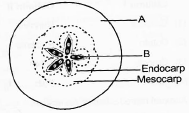
(i) Since ___A___ is associated with fruit, it is called as ___(i)___ .
(ii) Since ___B___ is present, fruit cannot be called as ___(ii)___ .
1. A - Pericarp, (i) - True fruits
2. B - Seed, (ii) - Ex-albuminous
3. A - Thalamus, (i) - True fruit
4. B - Seed, (ii) - Parthenocarpic
Arrange the following stages of microspore development into pollen grain, in the correct sequence
1. b, c, d, and a
2. b, d, a and c
3. a, c, b and d
4. b, a, d and c
Choose the correct statements
a. Perisperm is the persistant nucellus in the seeds of black pepper.
b. Single large cotyledon in grass is situated towards lateral side of the embryonal axis.
c. Seeds are the basis of agriculture.
d. Citrus has only one embryo in a seed.
1. Only a
2. Only a & b
3. Only a, b & c
4. a, b, c & d
When the embryosac develops from a single functional megaspore [the other three get generate], it is called as:
| 1. | Monosporic | 2. | Bisporic |
| 3. | Trisporic | 4. | Tetrasporic |
Identify the plant pollinated by insects that, in many species, emit a scent of decaying flesh from the inflorescence, in order to attract insects:
| 1. | Yucca | 2. | Amorphophallus |
| 3. | Zostera | 4. | Vallisneria |
Which of the given is not related to wind pollination?
1. Flowers are nectraless, odourless and colourless
2. Versatile statements in grasses
3. Dry, unbranched short stigma
4. Winged pollens in Pinus
Find the incorrect statement with respect to Commelina
1. Cleistogamous flowers
2. Assured seed set
3. Abiotic pollinators
4. No anthesis
| 1. | ovary is the enlarged apical portion of the pistil; the ovary contains ovules, which develop into seeds upon fertilization |
| 2. | ovary is the enlarged basal portion of the pistil; the ovary contains ovules, which develop into seeds upon fertilization |
| 3. | ovary is the enlarged basal portion of the pistil; the ovary contains ovules, which develop into fruits upon fertilization |
| 4. | ovary is the enlarged apical portion of the pistil; the ovary contains ovules, which develop into fruits upon fertilization |
What will be the ploidy of endosperm of a seed produced after crossing tetraploid female plant with tetraploid male plant?
1. Pentaploid
2. Hexaploid
3. Diploid
4. Triploid
| Assertion (A): | Cultivation of hybrids has tremendously increased the productivity. |
| Reason (R): | If hybrids are made into apomicts, there is segregation of characters in the hybrid progeny.- |
| 1. | Both (A) and (R) are true and (R) is the correct explanation of (A). |
| 2. | Both (A) and (R) are true but (R) is not the correct explanation of (A). |
| 3. | (A) is true but (R) is false. |
| 4. | Both (A) and (R) are false. |
The function of male sex accessory ducts and glands are maintained by:
1. Hypothalamic releasing hormone
2. Pitutary gonadotropins
3. Adrenal cortex steroids
4. Testicular androgens
In 'test-tube baby' procedure:
1. Fertilization is in-vitro but embryo development is in-vivo
2. Fertilization is in-vivo but embryo development is in-vitro
3. Both fertilization and embryo development are in-vitro
4. Both fertilization and embryo development are in-vivo
Embryo with more than 16 blastomeres formed due to in vitro fertilisation is transferred into
| 1. | uterus | 2. | Fallopian tube |
| 3. | fimbriae | 4. | cervix |
Which of the following events is not associated with ovulation in human female?
1. Decrease in oestradiol
2. Full development of Graafian follicle
3. Release of secondary oocyte
4. LH surge
Pills, implants and IUDs are very effective if taken within __________ of coitus.
1. 5 days
2. 72 hours
3. 30 days
4.15 days
Milk produced by alveoli is stored in
| 1. | Lobes | 2. | Lumen |
| 3. | Duct | 4. | Glandular Tissue |
At puberty, how many primary follicles are there in each ovary in a female?
1. 60000-80000
2. 120000-160000
3. 30000-40000
4. 12000
Identify the hormones that are secreted in large amount prior to ovulation :
| A. | LH |
| B. | FSH |
| C. | Estrogen |
| D. | Progesterone |
1. A only
2. A & B only
3. A,B & C only
4. A,B,C & D
Which is not a common mode of action between LNG20 and oral pill?
1. Inhibition of ovulation
2. Suppression of sperm motility and reduction of fertilizing ability of sperm
3. Alteration in quality of cervical mucus
4. Inhibition of implantation
Which of the following statements are true with respect to polar body?
1. Non functional by-products of oogenesis
2. First polar body is formed during the reductional division of the primary oocyte
3. Second polar body is formed during unequal division of the secondary oocyte
4. All of these
Which one of the following structures is last to appear during foetal development ?
1. Heart
2. Limbs and digits
3. Appearance of hair on head
4. Formation of eyelashes
Oral contraceptives do not work by
| 1. | Inhibition of ovulation |
| 2. | Changing the consistency of cervical mucus |
| 3. | Antagonistic action on gonadotropins |
| 4. | Spermicidal action |
During parturition, a pregnant woman is having prolonged labour pains and child birth has to be fastened. It is advisable to administer a hormone that can
| 1. | increase the metabolic rate. |
| 2. | release glucose in the blood. |
| 3. | stimulate the ovary. |
| 4. | activate smooth muscles. |
| 1. | Cleavage divisions in early embryonic stages are mitotic divisions. |
| 2. | Embryo with 4-8 cells is called as morula. |
| 3. | Implantation occurs at the stage of blastocyst. |
| 4. | Placenta acts as an endocrine tissue and produces some hormones. |
Which one of the following is not an Assisted Reproductive Technology (ART) used by childless couples to have children?
| 1. | ZIFT | 2. | IUD |
| 3. | IVF | 4. | IUT |
| 1. | Increased contraceptive efficiency |
| 2. | Prevention of ovulation |
| 3. | Prevention of implantation |
| 4. | Increased sexual desire and drive |
| 1. | Inhibiting ovulation |
| 2. | Inhibiting implantation |
| 3. | They alter the quality of cervical mucus to prevent/retard the entry of sperms |
| 4. | All of these |
The IUPAC name of the compound

1. 3,3-diethyl-4-methyl-5 (methylethyl)octane
2. 3,3-diethyl-5-isopropyl-4-methyloctane
3. 4-isopropyl-5-methyl-6,6-diethyloctane
4. 6,6-diethyl-4-isopropyl-5-methyloctane
The correct structure of 3,3-dimethyl butyne is:
1. 
2. 
3. 
4. 
The IUPAC name of the compound is-
\(CH_2=C-CH_2-C \equiv CH\\ ~~~~~~~~~~~~~|\\ ~~~~~~~~~~~~CH_3\)
1. 2-Methylpent-1-en-4-yne
2. 4-Methylpent-4-en-1-yne
3. 2-Methylpent-2-en-4-yne
4. 4-Methylpent-1-en-4-yne
The IUPAC name of the compound CH3CONH(Br) is:
1. 1-Bromoacetamide
2. N-Bromoethanamide
3. Ethanoyl bromide
4. None of the above
The correct order of resonance energy among the given below compounds is:
1. III>I>II
2. II>I>III
3. I>II>III
4. III>II>I
In the following mechanism, the chain termination step is:
| (i) |  |
| (ii) |  |
| (iii) |  |
| (iv) |  |
1. (i)
2. (ii)
3. (iii)
4. (iv)
The IUPAC name of  is:
is:
(1) propene-1, 3-dial
(2) Propene-1, 3-dicarbaldehyde
(3) Pent-3-ene-1, 5-dial
(4) Pent-2-ene-1, 5-dial
The IUPAC name of
is:
(1) Butane-1,4-dicarbonitrile
(2) Ethane-1, 2-dicarbonitrile
(3) Ethane-1, 2-dinitrile
(4) Butane-1, 4-dinitrile
The IUPAC name of the following compound is:

1. 2, 3-Dihydroxy-4-methylpentanal
2. 1-oxo-2,3-Dihydroxy-4-methylpentane
3. 2,3-Dihydroxy-4-methylpentanone
4. 1, 2-Dihydroxy-3-methylbutanecarbaldehyde
Ph-CH=CH-COOH
The IUPAC name is:
1. 3-Phenyl prop-2-enoic acid
2. 3-Phenol prop-1-enoic acid
3. 3-Carboxy-prop-1-ene benzene
4. But-2-enoic acid
The stability of 2,3-dimethyl but-2-ene is more than 2-butene. This can be explained in terms of:
1. resonance
2. hyperconjugation
3. electromeric effect
4. inductive effect
Only two isomeric monochloro derivatives are possible for:
(1) n-butane
(2) 2,4-dimethylpentane
(3) benzene
(4) 2-methylbutane
Which amongst the following is the most stable carbocation :-
| 1. | \(\mathrm{CH}_3 \stackrel{+}{\mathrm{C}}\mathrm{H}_2\) | 2. | \(\stackrel{+}{\mathrm{C}} \mathrm{H}_3\) |
| 3. |  |
4. |  |
Which of the following is the most correct electron displacement for a nucleophilic reaction to take place?
| 1. |  |
| 2. |  |
| 3. |  |
| 4. |  |
The incorrect IUPAC name among the following is:
| 1. |  |
| 2. |  |
| 3. |  |
| 4. |  |
Rank the following in order of decreasing nucleophilicity in an aprotic solvent:
1.
2.
3.
4.
The pair of structures that does not represent isomers is:
| 1. | 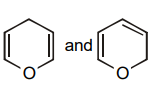 |
2. | 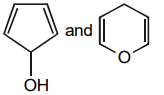 |
| 3. | 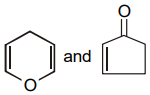 |
4. | 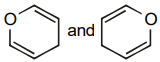 |
The \(C - H\) bond distance is longer in -
| 1. | \(C_2H_2\) | 2. | \(C_2H_4\) |
| 3. | \(C_2H_6\) | 4. | \(C_2H_2Br_2\) |
Which of the following has a zero dipole moment?
1. 1-butene
2. cis-2-butene
3. trans-2-butene
4. 2 methyl-1-propene
The total number of isomers possible for the molecular formula C₇H₈O are:
1. 3
2. 4
3. 5
4. 6
Two charges each equal to 2μC are 0.5m apart. If both of them exist inside the vacuum, then the force between them is
(1) 1.89 N
(2) 2.44 N
(3) 0.144 N
(4) 3.144 N
The magnitude of electric field intensity E is such that, an electron placed in it would experience an electrical force equal to its weight is given by
(1) mge
(2)
(3)
(4)
The electric intensity due to an infinite cylinder of radius R and having charge q per unit length at a distance r(r > R) from its axis is
(1) Directly proportional to r2
(2) Directly proportional to r3
(3) Inversely proportional to r
(4) Inversely proportional to r2
Figure shows three points A, B and C in a region of uniform electric field . The line AB is perpendicular and BC is parallel to the field lines. Then which of the following holds good. Where and VC represent the electric potential at points A, B and C respectively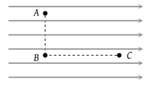
1.
2.
3.
4.
The capacity of parallel plate condenser depends on
1. The type of metal used
2. The thickness of plates
3. The potential applied across the plates
4. The separation between the plates
Eight small drops, each of radius r and having same charge q are combined to form a big drop. The ratio between the potentials of the bigger drop and the smaller drop is
1. 8 : 1
2. 4 : 1
3. 2 : 1
4. 1 : 8
When air in a capacitor is replaced by a medium of dielectric constant K, the capacity:
1. Decreases K times
2. Increases K times
3. Increases K2 times
4. Remains constant
In an adjoining figure are shown three capacitors C1, C2 and C3 joined to a battery. The correct condition will be (Symbols have their usual meanings) :
1. Q1 = Q2 = Q3 and V1 = V2 = V3 = V
2. Q1 = Q2 + Q3 and V = V1 + V2 + V3
3. Q1 = Q2 + Q3 and V = V1 + V2
4. Q2 = Q3 and V2 = V3
Three condensers each of capacitance 2F are put in series. The resultant capacitance is
1. 6F
2.
3.
4. 5F
Four condensers are joined as shown in the adjoining figure. The capacity of each is 8 μF. The equivalent capacity between the points A and B will be
1. 32 μF
2. 2 μF
3. 8 μF
4. 16 μF
Two capacitors \(C_1 = 2~\mu\text{F}\) and \(C_2 = 6~\mu \text{F}\) in series, are connected in parallel to a third capacitor \(C_3= 4~\mu\text{F}\). This arrangement is then connected to a battery of \(\text{emf}= 2~\text{V}\), as shown in the figure. How much energy is lost by the battery in charging the capacitors?
1. \(22\times 10^{-6}~\text{J}\)
2. \(11\times 10^{-6}~\text{J}\)
3. \(\frac{32}{3}\times 10^{-6}~\text{J}\)
4. \(\frac{16}{3}\times 10^{-6}~\text{J}\)
A capacitor of capacity C1 is charged upto V volt and then connected to an uncharged capacitor of capacity C2. Then final potential difference across each will be
1.
2.
3.
4.
A network of four capacitors of capacity equal to and C4 = 4 C are connected in a battery as shown in the figure. The ratio of the charges on C2 and C4 is
(1)
(2)
(3)
(4)
An isolated sphere of radius \(R\) contains a uniform volume distribution of positive charge. Which of the curve on the graph below correctly illustrates the dependence of the magnitude of the electric field of the sphere as a function of the distance \(r\) from its centre?

1. A
2. B
3. C
4. D
| 1. | \(4~\text{cm}\) from \(2~\mu\text{C}.\) |
| 2. | \(2~\text{cm}\) from \(2~\mu\text{C}.\) |
| 3. | \(2~\text{cm}\) from \(8~\mu\text{C}.\) |
| 4. | \(3~\text{cm}\) from \(8~\mu\text{C}.\) |
A cube of side a has a charge \(q\) at each of its vertices. The net electric field intensity at its centre is:
(\(r\) is the distance between a corner and the centre, and \(k=1/4\pi \varepsilon_0\) )
1. zero
2. \(kq/r^2\)
3. \(12kq/r^2\)
4. \(6kq/r^2\)
Which of the following is not the property of charge?
1. Like point charges repel each other
2. For an isolated system, the net charge is conserved
3. Specific charge is invariant
4. Charge is quantized
Charge Q is distributed uniformly in a spherical region of radius R. Which if the following roughly represents the variation of the electric field (E) versus distance (r) from the center of the sphere?
| 1. |  |
2. |  |
| 3. |  |
4. |  |
Two charges are placed at a certain distance apart in the air. If a glass slab is introduced between them, then the force between the two charges will
1. Become zero
2. Decrease
3. Increase
4. Remain the same
A long thin rod is charged such that charge per unit length of the rod is . The rod is inserted into a hollow spherical surface of radius R. Maximum electric flux coming out the surface is
1.
2.
3.
4.


