 Target TestContact Number: 8527521718Target TestContact Number: 8527521718
Which set of reactants among the following produces anisole?
1. CH3CHO, RMgX
2. C6H5OH, NaOH, CH3I
3. C6H5OH, neutral FeCl3
4. C6H5-CH3, CH3COCl, AlCl3
The general molecular formula, which represents the homologous series of alkanols is
1. CnH2nO2
2. CnH2nO
3. CnH2n+1O
4. CnH2n+2O
The solubility of phenol in water is lower. This can be attributed to:
1. Non-polar nature of phenol
2. Acidic nature of -OH group
3. Non-polar hydrocarbon part in phenol
4. None of the above
Phenol and benzoic acid can be distinguished by:
1. Aqueous NaHCO3
2. Aqueous NaNO3
3. Aqueous NaOH
4. Conc. H2SO4
By which reaction, ethyl chloride can be converted into diethyl ether?
1. Wurtz synthesis
2. Grignard reaction
3. Perkin's reaction
4. Williamson's synthesis
The dehydration of neo-pentanol yields mainly:
| 1. |  |
| 2. |  |
| 3. |  |
| 4. | None of the above |
In the following sequence of reactions, the product (C) is:
CH3CHO (A) (B) (C)
1. Alcohol.
2. Ether.
3. Alkene.
4. None of the above.
The value of C-O-C angle in ether molecule is :
1. 180
2. 150
3. 90
4. 110
The products formed in the following reaction, C6H5-O-CH3 + HI are-
1. C6H5OH and CH3I
2. C6H5I and CH3OH
3. C6H5CH3 and HOI
4. C6H6 and CH3OI
Butan-2-ol is a-
1. Primary alcohol
2. Secondary alcohol
3. Tertiary alcohol
4. None of the above
Primary alcohols can be obtained from the reaction of the RMgX with:
1. HCHO
2. H2O
3. CO2
4. CH3CHO
The commonly used dehydrating agent in the preparation of an ester is :
1. P2O5
2. Anhydride CaCl2
3. Anhydride AlCl3
4.Conc. H2SO4
Which of the following is most acidic?
1. p-cresol
2. p-chlorophenol
3. p-nitrophenol
4. p-aminophenol
A compound X with molecular formula C3H8O can be oxidised to a compound Y with the molecular formula C3H6O2. X is most likely to be:
1. Primary alcohol
2. Secondary alcohol
3. Aldehyde
4. Ketone
Which represents Riemer-Tiemann reaction?
| (a) |  |
| (b) |  |
| (c) |  |
| (d) |  |
Isopropyl alcohol and n-propyl alcohol are:
1. Position isomers
2. Chain isomers
3. Functional isomers
4. None of the above
The most acidic compound among the following is:
| 1. |  |
2. |  |
| 3. |  |
4. |  |
The compound B formed in the following sequence of reactions,
CH3CH2CH2OHAB will be:
1. Propyne
2. Propene
3. Propanal
4. Propane


can be repared from williamson's synthesis using
| 1. |  |
| 2. |  |
| 3. |  |
| 4. | All of these |
1. 
2. C6H5CH2Cl and
3.
4. All of these
Methanol and ethanol can be distinguished by the following:
1. By reaction with metallic sodium
2. By reaction with caustic soda
3. By heating with iodine and washing soda
4. By heating with zinc and inorganic mineral acid
The number of moles of HI
consumed by the given compound is:
| 1. | 1 | 2. | 2 |
| 3. | 3 | 4. | 4 |
R-CH2-CH2OH can be converted into RCH2CH2COOH. The correct sequence of reagents is:
1. PBr3, KCN, H+
2. PBr3, KCN, H2
3. KCN, H+
4. HCN, PBr3, H+
The major product in the acid catalysed dehydration of 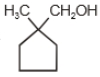 would be
1. 
2. 
3. 
4. 
Which of the following compounds is most prone to oxidation?
| 1. | \(\mathrm{CH}_3-\mathrm{CHOH}-\mathrm{CH}_3\) |
2. |  |
| 3. | \(\mathrm{CH}_3-\mathrm{CH}_2-\mathrm{O}-\mathrm{CH}_2-\mathrm{CH}_3\) |
4. |  |

| 1. |  |
2. |  |
| 3. |  |
4. |  |
Which of the following reagents can convert acetic acid into ethanol?
(1) Sn + HCl
(2) H2 + Pt
(3) LiAlH4 + ether
(4) Na + alcohol
Product C in the following sequence of reactions is:
\(C_2H_5Br \xrightarrow{NaOH\text{(aq)}}\ A \xrightarrow{Na}\ B\ \xrightarrow{CH_3I}\ C\)
| 1. | Butane | 2. | Ethane |
| 3. | Methyl ethyl ether | 4. | Propane |
Diethyl ether may be regarded as an anhydride of:
1. C2H5COOH
2. C2H5OH
3. C2H5CHO
4. C2H5COOC2H5
Phenol is:
1. a stronger base than NH3
2. an acid stronger than carbonic acid
3. an acid weaker than carbonic acid
4. None of the above
Identify Z in the following series,
CH3-CH2-CH2OH
1.
2.
3.
4.
Carbolic acid is the name used for:
1. Opium
2. Phenol
3. Chloroform
4. H2CO3
Phenyl ethyl ether with concentrated hydrobromic acid on boiling yields:-
1. Phenol and ethyl bromide
2. Bromobenzene and ethanol
3. Phenol and ethane
4. Bromobenzene and ethane
Phenol on treatment with dil. HNO3 at room temperature gives-
| 1. |  |
| 2. |  |
| 3. |  |
| 4. | All of the above |
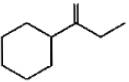
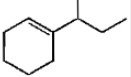
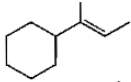
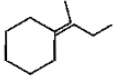
Which of the following is not the product of dehydration of
1. 
2. 
3. 
4. 
Among the following ethers, the one that will produce methyl alcohol on treatment with hot concentrated HI is:
| 1. |  |
2. |  |
| 3. |  |
4. |  |
Which of the following reaction sequences effectively transforms m-nitrophenol into resorcinol ?
1. Reduction, diazotisation, and hydrolysis
2. Hydrolysis, diazotisation, and reduction
3. Hydrolysis, reduction, and diazotisation
4. Diazotization, reduction, and hydrolysis
Find out P, Q , and R in the below-mentioned sequence of reactions:
| 1. |  |
| 2. |  |
| 3. |  |
| 4. |  |
Alkyl halides prepared by among the following reaction(s) is/are:
| I. | \(CH_3CH_2OH+HCl\xrightarrow{\bf{anh. ZnCl_2}}\) |
| II. | \(CH_3CH_2OH+HCl→\) |
| III. | \((CH_3)_3COH+HCl→ \) |
| IV. | \((CH_3)_2CHOH+HCl\xrightarrow{\bf{anh.ZnCl_2}}\) |
| 1. | I, III, and IV | 2. | I and II |
| 3. | Only IV | 4. | III and IV |
The compound, among the following, that will not be soluble in sodium hydrogen carbonate is:
| 1. | 2, 4, 6-Trinitrophenol | 2. | Benzoic acid |
| 3. | o-Nitrophenol | 4. | Benezenesulphonic acid |
Which of the following compounds produces methyl alcohol on treatment with hot concentrated HI?
| 1. |  |
| 2. |  |
| 3. |  |
| 4. |  |
The most acidic compound among the following is:
| 1. |  |
2. |  |
| 3. |  |
4. |  |
CH3 — O — CH(CH3)2 + HI → B (Product)
The product 'B' in the above mentioned reaction is-
1. CH3OH + (CH3)2CHl
2. lCH2OCH(CH3)2
3. CH3OC(CH3)2
4. CH3l + (CH3)2CHOH
The compound that is most difficult to protonate is:
| 1. |  |
2. |  |
| 3. |  |
4. |  |
Arrange the reactivity of alcohols in decreasing order for E1 elimination reaction:
| I |  |
| II |  |
| III |  |
| IV |  |
Select the correct answer from the codes given below :
Codes :
1. III > II > IV > I
2. II > III > IV > I
3. II > III > I > IV
4. III > II > I > IV
The product in the below mentioned reaction is:
| 1. |  |
| 2. |  |
| 3. | C6H5OC6H5 |
| 4. | C2H5OC2H5 |
The product 'B' in the below mentioned reaction is-
1. Phenol
2. Benzol
3. Sodium benzoate
4. Benzal
Consider the following reaction:
1.
2.
3.
4. None of these
In the following reaction sequence, X and Y are:

| 1. |  |
| 2. |  |
| 3. |  |
| 4. |  |
A dizonium salt reacts with a phenol to give an azo dye.
This reaction is known as:
(1) diazotisation
(2) condensation
(3) coupling
(4) reduction
Which of the following substituted phenols is the strongest acid?
| 1. | 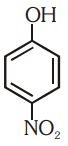  |
2. | 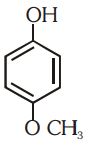  |
| 3. | 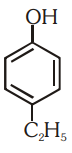  |
4. | 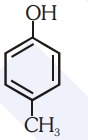  |


