 Target TestContact Number: 8527521718Target TestContact Number: 8527521718
Which of the following taxonomic categories are correctly matched to their standard termination of names with respect to biological classification of plants?
| I | Division: | - phyta |
| II | Class: | - opsida |
| III | Order: | - ales |
| IV | Family: | - idae |
1. I, II, IV
2. I, II, III
3. II, III, IV
4. I, II, III, IV
Consider the following statements:
| I: | The roots hair are unicellular and arise from the region of maturation. |
| II: | Terminal buds of stems may get modified to thorns. |
| III: | Leaves originate from shoot apical meristem and are arranged in an acropetal order. |
Which of the above statements are true?
1. I and II only
2. I and III only
3. II and III only
4. I, II and III
The hilum is a scar on the
1. seed, where funicle was attached
2. fruit, where it was attached to the pedicel
3. fruit, where style was present
4. seed, where micropyle was present
Genus has
| 1. | More common character possessing group of one species than other species |
| 2. | More common character possessing group of species than species of other genera |
| 3. | Less common character possessing group of species than other phyla |
| 4. | Less common character possessing group of one species than other species |
Cats come under Felis. Which taxon are we talking about?
1. Class
2. Order
3. Genus
4. Species
Order and higher taxon are identified on the basis of-
| 1. | Similarities in characters |
| 2. | Dissimilarities in characters |
| 3. | Aggregates of characters |
| 4. | Both a and c |
Leaves are modified into tendrils in:
1. Parkinsonia
2. Pea
3. Ranunculus
4. Oxalis
Which of the following is not the member of Liliaceae:
1. Tulip, Gloriosa, Aloe
2. Colchicum
3. Pisum
4. Asparagus
Which out of the following was not the basis of the five kingdom classification?
1. Cell structure
2. Thallus organization
3. Phylogenetic Relationship
4. Gross morphology
Comma shaped bacteria are
1. coccus
2. Vibrio
3. Bacilli
4. Spirillum
Identify the odd one out with respect to the formation of the spores.
| 1. | Basidiospore | 2. | Ascospore |
| 3. | Zoospore | 4. | Aplanospore |
Domain Eukarya includes how many kingdoms (with respect to six kingdom system)?
1. Two
2. Three
3. One
4. Four
species are considered as
(1) artificial concept of human mind which cannot be defined in absolute terms
(2) real units of classificatiion devised by taxonomists
(3) real basic units of classification
(4) the lowest units of classification
Which among the following is not a prokaryote?
1. Saccharomyces
2. Mycobacterium
3. Nostoc
4. Oscillatoria
Difference between Virus and Viroid is
1. Absence of protein coat in viroid but presence of virus
2. Presence of low molecular weight RNA in virus but absence in viroid
3. Both 1 and 2
4. None of the above
The placenta is attached to the developing seed near the
1. Testa
2. Hilum
3. Micropyle
4. Chalaza
Choose the correct from the followings:-
| 1. | Mangifera, is a name of species |
| 2. | Polymoniales, is a name of family |
| 3. | Dicotyledonae, is a name of division |
| 4. | Triticum, is a name of genus |
Identify the correct features of Mango and Coconut fruits.
(i) In both fruit is a drupe
(ii) Endocarp is edible in both
(iii) Mesocarp in Coconut is fibrous, and in Mango, it is fleshy
(iv) In both, the fruit develops from the monocarpellary ovary
Select the correct option from below :
(1) (i), (iii) and (iv) only
(2) (i), (ii) and (iii) only
(3) (i) and (iv) only
(4) (i) and (ii) only
Aestivation of petals in the flower of cotton is correctly shown in:
| 1. |  |
2. |  |
| 3. |  |
4. |  |
Practical purpose of taxonomy or classification is to:
| 1. | facilitate the identification of unknown species |
| 2. | explain the origin of organisms |
| 3. | know the evolutionary history |
| 4. | identify medicinal plants |
Consider the following characters:
I. Air bladder
II. Operculum
III. Viviparity
The characters present in bony fishes include:
| 1. | I, II and III | 2. | I and III only |
| 3. | I and II only | 4. | II and III only |
Which of the following elements is present in higher proportion [% weight of the total] in Earth's crust with respect to the average composition of a human body?
1. Carbon
2. Nitrogen
3. Sulfur
4. Magnesium
Birds are not characterized by:
1. Forelimbs modified into wings
2. Fully ossified endoskeleton
3. Skin dry without glands except for oil gland
4. Oviparous and external fertilization
Echinoderms are not characterized by:
| 1. | An absence of excretory system |
| 2. | Bisexual animals |
| 3. | Usually external fertilization |
| 4. | Indirect development with free swimming larva |
Which of the following characteristic features always holds true for the corresponding group of animals?
| 1. | Viviparous | Mammalia |
| 2. | Possess a mouth with an upper and a lower jaw | Chordata |
| 3. | 3-chambered heart with one incompletely divided ventricle | Reptilia |
| 4. | Cartilaginous – endoskeleton | Chondrichthyes |
Which one of the following phyla is correctly matched with its two general characteristics?
| 1. | Arthropoda | − Body divided into head, thorax and abdomen and respiration by mouth |
| 2. | Chordata | − Notochord at early stage only and separate anal and urinary openings to the outside |
| 3. | Echinodermata | − Pentamerous radial symmetry and mostly internal fertilization |
| 4. | Mollusca | − Normally oviparous and development through a trochophore or veliger larva |
In a normal adult, ascending order of concentration of following molecules is
1. Na>K>Fe>Cu
2. Na>K>Cu>Fe
3. Fe>Na>K>Cu
4. Na>Fe>K>Cu
Collar cells are present in the members of which phyla
1. Echinodermata
2. Coelenterata
3. Ctenophora
4. Porifera
Which of the following is called pearl oyster?
1. Dentalium
2. Pinctada
3. Pila
4. Aplysia
Ancylostoma is also known as
1. Pinworm
2. Hookworm
3. Flatworm
4. Filarial worm
Which one of the graphs show the effect of temperature on the velocity of a typical enzymatic reaction?
The four elements making 99 % of living system are:
| 1. | CHOS | 2. | CHOP |
| 3. | CHON | 4. | CNOP |
Stinging capsule present in Cnidarians is called
1.Nematocysts
2.Choanocytes
3.Cnidocytes
4.Both 2 and 3
Which of the following is true about Lipids
1.It is a polymer of Fatty acids and Glycerol
2.Water soluble
3.Fatty acids can be saturated or unsaturated
4.both 1 and 3
Which of the following is true?
1. All the elements present in a sample of earth’s crust are also present in a sample of living tissue
2. Carbon and Hydrogen are present in more amount in any living organism than earth’s crust.
3. Carbon and Hydrogen are present in more in living organisms than in non living matter.
4. All of the above
Enzymes work at optimum temperature. Over a range of 0 to 400C, what would happen to the rate of enzyme controlled reactions for every 100C rise in temperature?
| 1. | The rate doubles itself |
| 2. | Decreases by half |
| 3. | No effect |
| 4. | First increases then decreases |
Which of the following class of enzymes helps in catalysing a transfer of a group (other than hydrogen) between a pair of substrates?
1. Ligases
2. Lyases
3. Transferases
4. Hydrolases
The molecule represented is :-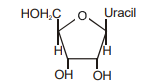
| 1. | uridine and it is pyrimidine |
| 2. | uridylic acid and it is nucleoside |
| 3. | uridylic acid and it is nucleotide |
| 4. | uridine and it is nucleoside |
Which of the following is a correct match with respect to members listed and corresponding taxon?
| 1. | Earthworm, silkworm, hookworm – Annelida |
| 2. | Sea hare, sea lily, sea urchin – Echinodermata |
| 3. | Cuttle fish, devil fish, apple snail – Mollusca |
| 4. | Sea horse, flying fish, dog fish – Chondrichthyes |
Choose the incorrect match.
|
1. |
Arachidonic acid |
- |
20C fatty acid including carboxyl carbon |
|
2. |
Lecithin |
- |
Phospholipid found in cell membrane |
|
3. |
Cytidine |
- |
Nitrogenous base of DNA |
|
4. |
Vinblastin |
- |
Secondary metabolite used as anti-cancer drug |
The a-D-glucose and b-D-glucose differ from each other due to difference in carbon atom with respect to its
1. conformation
2. configuration
3. number of OH-groups
4. size of hemiacetal ring
Sucrose in water is dextrorotatory, when boiled with dil.HCl, the solution becomes leavorotatory, In this process the sucrose breaks into
1. L-glucose + D-fructose
2. L-glucose + L-fructose
3. D-glucose + D-fructose
4. D-glucose + L-fructose
Which is not a true statement?
1. a-carbon of a-amino acid is asymmetric except glycine
2. All proteins are found in L-form
3. Human body can synthesis all proteins they need
4. At pH = 7 both amino and carboxylic groups exist in ionised form
An amine among the following that acts as hormone is :
1. Thyroxine
2. Oxypurin
3. Insulin
4. Progesterone
Consider the given reaction, 2SO2 + O2 2SO3
6.4 g SO2 and 3.2 g O2 to form SO3 . The mass of SO3 formed is:
1. 32 g
2. 16 g
3. 8 g
4. 4 g
Calculate the number of ions present in 2L of a solution of 1.6 M K4[Fe(CN)6]:
| 1. | 4.8 x 10²² | 2. | 4.8 x 10²³ |
| 3. | 9.6 x 1024 | 4. | 9.6 x 10²² |
1 c.c of N2O at NTP contains :
1. atoms
2. molecules
3. electrons
4. All the above
The mass of carbon present in 0.5 mole of K4[Fe(CN)6] is:
1. 1.8 g
2. 18 g
3. 3.6 g
4. 36 g
O
ll
NH2-CH-C-NH-CH2-CO2H
l
CH3
Identify the amino acid obtained by hydrolysis of the above compound :-
1. Glycine
2. Alanine
3. Both (1) and (2)
4. None of the above
One of the essential α-amino acids is:
| 1. | Lysine | 2. | Glycine |
| 3. | Serine | 4. | Proline |
If the Avogadro number NA, is changed from 6.022 x 10²³ mol-1 to 6.022 x 10²⁰ mol-1 this would change:
1. The definition of mass in units of grams.
2. The mass of one mole of carbon.
3. The ratio of chemical species to each other in a balanced equation.
4. The ratio of elements to each other in a compound.
What is the empirical formula of vanadium oxide, if 2.74 g f the metal oxide contains 1.53 g of metal:
1.
2. VO
3.
4.
Cellulose is a straight-chain polysaccharide composed of only :
1. D-glucose units joined by - glycosidic linkage.
2. D-glucose units joined by - glycosidic linkage.
3. D-galactose units joined by - glycosidic linkage.
4. D-galactose units joined by - glycosidic linkage.
A linkage present in proteins and peptides is:
| 1. |  |
2. |  |
| 3. |  |
4. |  |
| 1. | Sr | 2. | Be |
| 3. | Mg | 4. | Ca |
Write the structure of alanine at pH = 2 and
pH = 10
1.
2.
3.
4. None of above
| Assertion (A): | Moist air is heavier than dry air. |
| Reason (R): | The molecular mass of H2O is more than that of the air. |
| 1. | Both (A) and (R) are true and (R) is the correct explanation of (A). |
| 2. | Both (A) and (R) are true but (R) is not the correct explanation of (A). |
| 3. | (A) is true but (R) is false. |
| 4. | Both (A) and (R) are false. |
The number of valence electrons present in 0.53 grams of Na2CO3 is:
1.
2.
3.
4.
| Assertion (A): | The empirical mass of ethene is half of its molecular mass. |
| Reason (R): | The empirical formula represents the simplest whole-number ratio of the various atoms present in a compound. |
| 1. | Both (A) and (R) are True and (R) is the correct explanation of (A). |
| 2. | Both (A) and (R) are True but (R) is not the correct explanation of (A). |
| 3. | (A) is True but (R) is False. |
| 4. | (A) is False but (R) is True. |
The following data was obtained when dinitrogen and dioxygen react together to form different compounds:
| Mass of dinitrogen | Mass of dioxygen | |
| i. | 14 g | 16 g |
| ii. | 14 g | 32 g |
| iii. | 28 g | 32 g |
| iv. | 28 g | 80 g |
The law of chemical combination applicable to the above experimental data is:
1. Law of reciprocal proportions
2. Law of multiple proportions
3. Law of constant composition
4. None of the above.
The coordinates of a moving particle at any time \(t\) are given by \(x = \alpha t^3\) and \(y=\beta t^3.\) The speed of the particle at time \(t\) is given by:
1. \( \sqrt{\alpha^2+\beta^2} \)
2. \( 3 t \sqrt{\alpha^2+\beta^2} \)
3. \( 3 t^2 \sqrt{\alpha^2+\beta^2}\)
4. \( t^2 \sqrt{\alpha^2+\beta^2}\)
The acceleration \(a\) in m/s2 of a particle is given by where t is the time. If the particle starts out with a velocity, \(u=2\) m/s at t = 0, then the velocity at the end of \(2\) seconds will be:
1. \(12\) m/s
2. \(18\) m/s
3. \(27\) m/s
4. \(36\) m/s
The graph between the displacement \(x\) and time \(t\) for a particle moving in a straight line is shown in the figure.
During the interval OA, AB, BC and CD the acceleration of the particle is:
| OA | AB | BC | CD | |
| 1. | + | 0 | + | + |
| 2. | – | 0 | + | 0 |
| 3. | + | 0 | – | + |
| 4. | – | 0 | – | 0 |
A body starts from rest with uniform acceleration. If its velocity after n second is v, then its displacement in the last two seconds is
1.
2.
3.
4.
A boy standing at the top of a tower of \(20\) m height drops a stone. Assuming \(g=10\) m/s2, the velocity with which it hits the ground will be:
1. \(20\) m/s
2. \(40\) m/s
3. \(5\) m/s
4. \(10\) m/s
A particle moves a distance x in time t according to equation The acceleration of the particle is proportional to,
1.
2.
3.
4.
A particle moves along a straight line and its position as a function of time is given by \(x= t^3-3t^2+3t+3\)
| 1. | stops at \(t=1~\text{s}\) and reverses its direction of motion. |
| 2. | stops at \(t= 1~\text{s}\) and continues further without a change of direction. |
| 3. | stops at \(t=2~\text{s}\) and reverses its direction of motion. |
| 4. | stops at \(t=2~\text{s}\) and continues further without a change of direction. |
A particle is moving such that its position coordinates (x, y) are (\(2\) m, \(3\) m) at time \(t=0,\) (\(6\) m,\(7\) m) at time \(t=2\) s, and (\(13\) m, \(14\) m) at time \(t=\) \(5\) s. The average velocity vector \(\vec{v}_{avg}\) from \(t=\) 0 to \(t=\) \(5\) s is:
1. \({1 \over 5} (13 \hat{i} + 14 \hat{j})\)
2. \({7 \over 3} (\hat{i} + \hat{j})\)
3. \(2 (\hat{i} + \hat{j})\)
4. \({11 \over 5} (\hat{i} + \hat{j})\)
In the following displacement \((x)\) versus time \((t)\) graph, at which points \(P, Q\) and \(R\) will the object's speed be increasing?

1. \(R\) only
2. \(P\) only
3. \(Q\) and \(R\) only
4. \(P,Q,R\)
A particle moves along a path \(ABCD\) as shown in the figure. The magnitude of the displacement of the particle from \(A\) to \(D\) is:
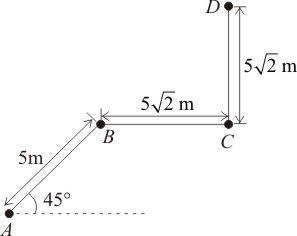
1. m
2. \(10\) m
3. m
4. \(15\) m
For the following acceleration versus time graph, the corresponding velocity versus displacement graph is:
| 1. |  |
2. |  |
| 3. |  |
4. |  |
The position-time \((x\text-t)\) graphs for two children \(A\) and \(B\) returning from their school \(O\) to their homes \(P\) and \(Q\) respectively are shown in the graph.

Choose the incorrect statement:
| 1. | \(B\) reaches home faster than \(A.\) |
| 2. | \(B\) overtakes \(A\) on the road twice. |
| 3. | \(B\) walks faster than \(A.\) |
| 4. | \(A\) lives closer to the school than \(B.\) |
A body is projected vertically in the upward direction from the surface of the earth. If the upward direction is taken as positive, then the acceleration of the body during its upward and downward journey is:
| 1. | Positive, negative | 2. | Negative, negative |
| 3. | Positive, positive | 4. | Negative, positive |
The position of an object moving along \(x\)-axis is given by \(x=a+bt^2\), where \(a=8.5\) m, \(b=2.5 \text{ ms}^{-2}\) and \(t\) is measured in seconds. Its average velocity between \(t=2.0\) s and \(t=4.0\) s is:
1. \(10~\text{m/s}\)
2. \(15~\text{m/s}\)
3. \(20~\text{m/s}\)
4. \(25~\text{m/s}\)
When brakes are applied to a moving vehicle, the distance it travels before stopping is called stopping distance. It is an important factor for road safety and depends on the initial velocity \({v_0}\) and the braking capacity, or deceleration, \(-a\) that is caused by the braking. Expression for stopping distance of a vehicle in terms of \({v_0}\) and \(a\) is:
| 1. | \(\dfrac{{v_o}^2}{2a}\) | 2. | \(\dfrac{{v_o}}{2a}\) |
| 3. | \(\dfrac{{v_o}^2}{a}\) | 4. | \(\dfrac{2a}{{v_o}^2}\) |
| 1. | \(0\) unit | 2. | \(2\) unit |
| 3. | \(4\) unit | 4. | \(3\) unit |

| Assertion (A): | Adding a scalar to a vector of the same dimension is a meaningful algebraic operation. |
| Reason (R): | Displacement can be added to distance. |
| 1. | Both (A) and (R) are True and (R) is the correct explanation of (A). |
| 2. | Both (A) and (R) are True but (R) is not the correct explanation of (A). |
| 3. | (A) is True but (R) is False. |
| 4. | Both (A) and (R) are False. |
| Assertion (A): | A particle having zero acceleration must have a constant speed. |
| Reason (R): | A particle having constant speed must have zero acceleration. |
| 1. | Both (A) and (R) are True and (R) is the correct explanation of (A). |
| 2. | Both (A) and (R) are True but (R) is not the correct explanation of (A). |
| 3. | (A) is True but (R) is False. |
| 4. | Both (A) and (R) are False. |
| 1. | \(\dfrac{\alpha-f}{1+\beta} \) | 2. | \(\dfrac{\alpha+f}{2(\beta-1)} \) |
| 3. | \(\dfrac{\alpha+f}{2(1+\beta)} \) | 4. | \(\dfrac{f-\alpha}{2(1+\beta)}\) |


